


Four important facts about trauma you should know:
- Trauma is any disturbing experience causing fear, helplessness, confusion, or other disruptive feelings with long‑lasting negative effects. (American Psychological Association).
- Trauma is often caused by a threatening or harmful event such as a serious accident, exposure to violence, natural disaster, or prolonged abuse or neglect.
- Trauma is stored in the body through many different mechanisms, such as the nervous system, tissues, and muscles.
- Unresolved trauma can have profound, lasting impacts not just on mental and emotional wellbeing, but on physical health too.
How unresolved trauma affects the body
There are many misconceptions when it comes to understanding trauma.
It is often thought of as something that lives solely in the mind: difficult memories, anxiety, fear, emotional distress or changes in the way we see ourselves and the world around us.
But trauma can affect so much more than our thoughts and emotions.
When traumatic experiences remain unresolved, the body can continue responding as though the danger you experienced is still present, even when the original threat passed long ago.
Over time, this ongoing state of activation or stress can influence sleep, energy, concentration, muscle tension, digestion and your overall sense of wellbeing.
Recognizing the connection between psychological and physical health can be an important part of understanding trauma – and finding the right path towards recovery.
We’re here to help.
Contact us today for a no-obligation conversation with one of our professionals.
Understanding the mind-body connection
Trauma doesn’t always stay in the past just because the event or experience is over.
When difficult experiences aren’t fully processed, their effects can keep shaping how the brain and body respond to everyday life.
The connection between psychological wellbeing and physical health is complex, but increasingly well understood.
As mentioned above, unresolved trauma can affect the nervous system, stress hormones, sleep, digestion, muscle tension and emotional regulation.
For some people, these effects may continue for years before they recognize a connection between what happened to them and how they feel today.
Understanding this mind-body relationship can be an important part of understanding trauma and, ultimately, recovery.
Let’s explore these effects in more detail.
The nervous system: When the body remains on alert

One of the most significant ways trauma can affect the body is through the nervous system.
Following a traumatic experience, your brain can become more sensitive to potential threats. The body’s fight, flight or freeze responses may become activated more easily, even when there is no immediate danger.
As a result, you may feel constantly on edge, easily startled, restless, or unable to fully relax.
Certain sounds, smells, places, or situations may unexpectedly bring back feelings associated with the original experience, triggering a physical stress response like a racing heart or dry throat even when you know, on a conscious level, that you are safe.
The important point is that these reactions are not a sign of weakness or that you are broken. These responses often reflect a nervous system that has learned to stay vigilant to protect you and keep you safe from further harm or threat.
The impact of chronic stress on the body
When the body’s stress response is constantly activated, it can become more than a little exhausting.
Trauma can influence the systems responsible for regulating stress hormones such as cortisol and adrenaline.
For someone living with unresolved trauma, this may feel like being unable to switch off properly. Even periods that should feel restful can bring physical tension or a sense that something is wrong, or that something bad will happen.
You may also experience aches and pain in the body and be more susceptible to viruses like colds and flu.
This is one reason trauma recovery cannot always be approached purely as a psychological process.
The body also needs an opportunity to experience safety, which is why recovery must include a multimodal approach that addresses the mind, body and spirit.
How we can help
At Centres for Health and Healing, we support individuals who have experienced various types of trauma, offering personalized, holistic treatment programs such as CBT, DBT, trauma-informed treatment and individualized therapy.
These programs help individuals understand the different aspects of themselves that may have been impacted by their past.
For example, cognitive behavioural therapy allows you to explore your thoughts and emotions and how they might have been affected by trauma, helping you to develop healthier perspectives and beliefs.
While mindfulness, yoga, and group support can help you understand the physical, spiritual and relational aspects of your past so that you can begin building compassion and resilience to help you re-establish a sense of connection and belonging.
All our programs cultivate safety, structure and stability so that you can begin exploring your past without feeling overwhelmed or emotionally stuck by what you experienced.
Trauma and physical tension
Emotional distress can also show up physically.
People carrying unresolved trauma may experience persistent muscle tension, headaches, jaw clenching, changes in posture or unexplained aches and pains.
Some may become highly aware of physical sensations, while others may feel disconnected from their bodies altogether.
Breathing patterns can change too. Someone who has spent a long time in a heightened state of stress may unconsciously breathe more shallowly or hold tension throughout their body.
These physical patterns are not necessarily evidence that trauma is the only cause of a particular medical symptom.
Healthcare professionals should always assess physical symptoms appropriately.
However, understanding the relationship between psychological stress and physical wellbeing can provide an important additional perspective.
The gut-brain connection
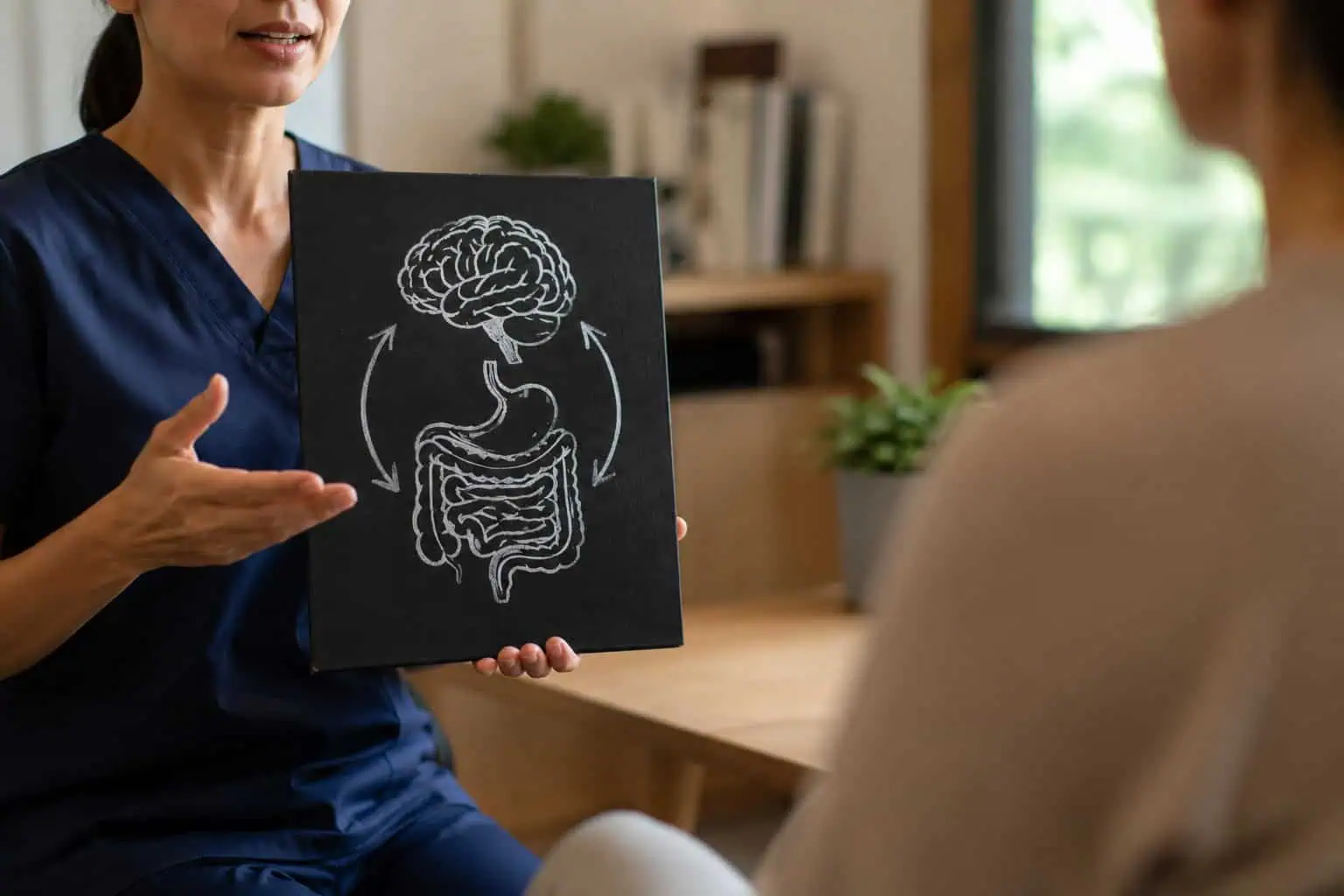
The connection between the brain and digestive system is another area where prolonged stress can become apparent.
The nervous system plays a vital role in digestion, and significant or prolonged stress can influence how the gastrointestinal system functions.
Some people experiencing unresolved trauma may notice changes in appetite, stomach discomfort, bloating or a change in their bowel habits.
Again, this does not mean that every digestive problem is caused by trauma. Rather, it highlights how deeply interconnected our physical and psychological systems are.
The body is not made up of completely separate compartments.
What happens emotionally can influence what happens physically, just as physical wellbeing can influence mood and resilience.
Emotional and behavioural effects
The impact of unresolved trauma can extend way beyond physical symptoms.
For instance, some people may experience anxiety, low mood, emotional numbness or dissociation. Others may struggle with relationships, trust, intimacy or managing intense emotions.
In some circumstances, individuals may turn towards alcohol, drugs, compulsive behaviours or other ways of trying to regulate overwhelming or unpleasant feelings.
These behaviours are sometimes misunderstood as poor choices or bad habits.
However, when you look at them through the lens of trauma, it can offer a completely different perspective.
These patterns may have developed as attempts to cope with distress that the person has not yet had the tools or support to process differently.
This does not take away personal accountability, far from it.
However, it cultivates greater understanding and compassion, both important starting points for change.
The physical signs of unresolved trauma

Every individual responds to trauma differently, and physical symptoms can have many possible causes.
However, some people experiencing unresolved trauma may notice symptoms such as:
- Difficulty sleeping or frequently waking up at night.
- Persistent muscle tension or restlessness.
- Headaches or unexplained aches and pains.
- Changes in appetite or digestion.
- Fatigue or low energy.
- Increased sensitivity to anxiety or stress.
- Difficulty concentrating.
- Feeling constantly “on edge” or alert.
- Changes in breathing or heart rate, especially during periods of anxiety.
These symptoms can cause additional worry and anxiety, particularly when you haven’t connected them with what you’ve been through.
Sometimes the body communicates distress in ways the conscious mind hasn’t fully processed yet.
In this way, symptoms can be the body’s attempt to bring attention to emotional wounds beneath the surface so they can be resolved.
Why treating trauma means looking at the whole person
If trauma can influence both psychological and physical wellbeing, recovery needs to take the whole person into account.
Trauma-informed treatment often involves approaches such as trauma-focused psychotherapy, somatic techniques like deep breathing, sensory exercises and movement, mindfulness, nervous-system regulation and other evidence- based therapies.
The best approach depends on the individual, their history, and their unique needs.
The goal of therapy is not simply to revisit what happened.
Effective trauma treatment is also about helping you develop a greater sense of safety, understand your responses and build healthier ways of relating to your thoughts, emotions and body.
Healing is not a linear process. You may have periods of progress alongside difficult moments, and recognizing this can be an important part of the process.
Trauma, shame and the difficulty of asking for help
One of the biggest challenges associated with unresolved trauma is that many people don’t always recognize their experiences as something for which they can seek support.
You may tell yourself you should be able to cope, minimize what happened, feel ashamed of your responses, or worry that asking for help shows a lack of strength or resilience.
For high-functioning individuals in particular, there can be a strong tendency to keep going.
But functioning well is not the same as healing.
Seeking professional support does not mean you are incapable of managing your life. It can simply mean recognizing that something deserves attention rather than continuing to carry it alone, which is what you need to move forward.
When should you seek support?

If you or a loved one is experiencing persistent physical or emotional symptoms, it is worth speaking with a qualified healthcare professional.
Physical symptoms should not automatically be attributed to psychological trauma.
A doctor can help rule out other medical explanations, while a mental health professional can explore whether past experiences may be contributing to what you’re experiencing.
You don’t have to wait until everything feels unmanageable or overwhelming before seeking support.
Sometimes, recognizing that something has changed is the first step.
Trauma treatment in Toronto, Canada
At our treatment centre in Canada, our team understands that trauma can affect many different layers of a person, not just one part of their life.
Our approach focuses on creating a safe, supportive environment where you can explore the underlying experiences contributing to your difficulties and begin developing healthier ways of responding.
If you or someone close to you is struggling with the effects of unresolved trauma, professional support can be an important step towards recovery.
Contact our professional team in Canada today, who will gladly provide further support and information.