


Think about the first hour of your day.
Perhaps you turn off your alarm and immediately check your phone. There are messages, emails, news alerts, and social media updates waiting. Before you have even left your bed, your mind is already processing information.
Then technology follows you through the rest of the day. It helps you work, communicate, navigate, learn, relax, and stay connected with people who may live hundreds of kilometres away.
In many ways, technology has made everyday life easier.
The difficulty is that we rarely have to consciously decide when to use it anymore. Our phones are simply there, constantly available and constantly asking for a little more of our attention.
That does not mean technology is inherently bad for your mental health.
The relationship is far more complicated.
The more useful question may be whether technology is supporting your life or beginning to take up space that once belonged to sleep, relationships, movement, reflection, and simple moments when your mind had nothing to respond to.
Finding balance is not about deleting every app or disappearing from the internet. It is about learning how to use technology without allowing it to consume all of your attention.
Technology is not the enemy
It is easy to talk about digital wellness as though the solution is simply spending less time online.
Real life is rarely that straightforward.
Technology helps us maintain friendships, work flexibly, find communities, access information, attend virtual appointments, and stay connected with people we care about. It can also support wellness through exercise, meditation, sleep, journaling, and mental health resources.
Research reflects some of this complexity. A 2024 meta-analysis involving more than 680,000 participants found that problematic social media use was negatively associated with wellbeing, while excessive use alone did not show the same clear relationship.
That distinction matters.
Someone might spend several hours online working, studying, creating, or talking with friends. Another person may spend much less time scrolling through content that consistently leaves them feeling anxious, inadequate, or unable to stop.
Screen time matters, but so does what you are doing, why you are doing it, and how you feel afterwards.
We’re here to help.
Contact us today for a no-obligation conversation with one of our professionals.
When connection becomes constant availability
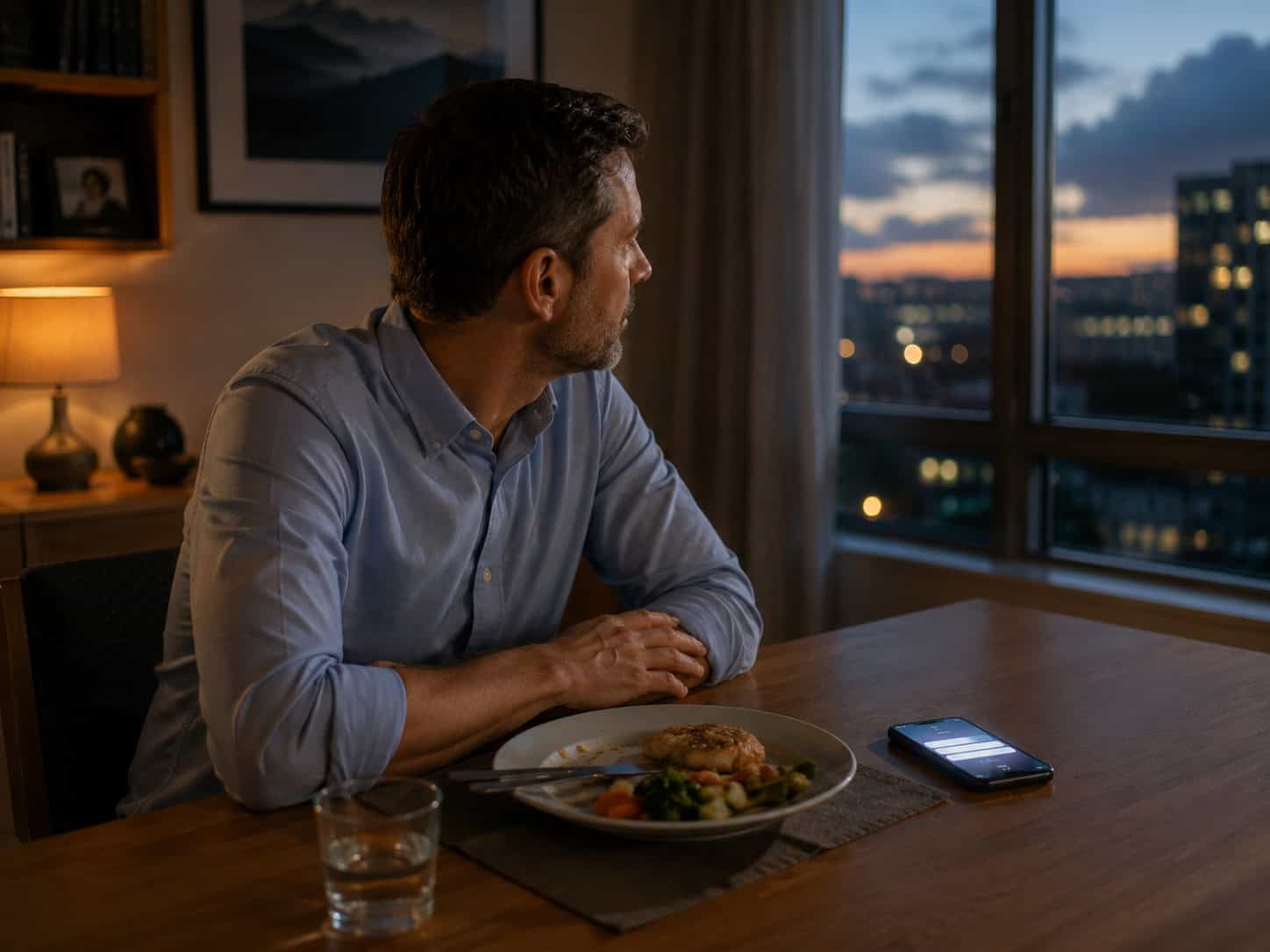
One of technology’s greatest strengths is also one of its biggest challenges.
We are incredibly reachable.
A work email can arrive during dinner. A group conversation continues late into the evening. News updates appear throughout the day, and there is rarely a clear moment when everything stops.
For some people, this creates a subtle expectation that they should always be available.
You may answer an email because leaving it until tomorrow makes you uncomfortable. Perhaps you pick up your phone during a film without really knowing why. Eventually, checking becomes automatic.
The problem is not necessarily the notification itself. It is the repeated interruption of your attention.
You may technically be resting while still responding to work. You may be spending time with family while half-following a conversation on your phone.
Over time, it becomes harder to feel fully present anywhere.
Social media and the comparison trap
Humans have always compared themselves to other people. Social media simply gives us far more people to compare ourselves with.
Within a few minutes, you can compare your career, appearance, relationships, home, parenting, social life, holidays, and productivity with hundreds of other people.
The comparison is rarely fair.
You are comparing the complete version of your own life, including the difficult days and insecurities, with fragments of somebody else’s life that they have chosen to show you.
Most of us understand this logically. Emotionally, comparison can still affect us.
You might close an app feeling strangely inadequate without being able to identify exactly why.
This does not mean social media always harms wellbeing. It can create community, humour, inspiration, information, and meaningful connection.
The important thing is noticing how certain platforms, accounts, or types of content consistently make you feel.
Your feed may be digital.
The emotions it creates are very real.
Your sleep deserves some protection
One of the clearest places where technology and wellbeing overlap is sleep.
You intend to check one thing before bed. Twenty minutes later, you are still scrolling, answering messages, reading the news, or watching another video.
Your body may be in bed, but your mind has not had much opportunity to slow down.
A 2024 systematic review involving more than 40,000 participants found associations between electronic media use and poorer sleep outcomes.
Technology is certainly not the only reason people sleep badly. Stress, anxiety, depression, work schedules, physical health, caffeine, medication, and other factors can all contribute.
But digital habits are one part of the picture that may be easier to change.
Try noticing what the final thirty minutes of your day usually look like.
Are you relaxing, or are you asking your brain to keep processing information right until you close your eyes?
Sometimes better digital balance begins with giving the day a clearer ending.
Signs your digital habits may be affecting your wellbeing

There is no universal number of screen-time hours that determines whether technology use is healthy or unhealthy.
A better question may be: What is technology beginning to replace?
It may be worth looking more closely at your habits if you:
- Reach for your phone automatically whenever you feel bored, anxious, or uncomfortable.
- Regularly lose sleep because you continue scrolling, gaming, or watching videos.
- Feel noticeably worse about yourself after spending time on certain platforms.
- Find it difficult to concentrate without checking notifications.
- Spend less time exercising, socializing, or doing things you once enjoyed.
- Repeatedly intend to reduce your screen time but struggle to do so.
- Use technology mainly to avoid difficult emotions or situations.
- Find it difficult to remain present during conversations without checking your device.
None of these behaviours automatically means you have an addiction or mental health condition.
What matters is whether the pattern is interfering with your sleep, relationships, responsibilities, emotional wellbeing, or ability to choose how you spend your time.
Creating healthier digital habits
Digital wellness does not require an extreme detox.
Taking a break from technology can be useful, but long-term balance usually comes from making smaller, more sustainable changes.
Start by identifying moments when your phone does not need to be involved. Perhaps it stays away during dinner, or you avoid checking social media during the first twenty minutes of your morning.
Notifications are another good place to start. Not every app deserves immediate access to your attention. Turning off non-essential alerts allows you to decide when you engage rather than constantly reacting.
It can also help to become more selective about what you consume. If particular accounts consistently leave you feeling anxious, angry, inadequate, or drained, consider whether they deserve a regular place in your attention.
Most importantly, protect the parts of life that technology can easily replace.
Go outside. Move your body. Cook. Read. Spend time with someone without simultaneously checking a screen.
And occasionally, before opening an app, ask yourself:
Why am I picking up my phone?
Sometimes there will be a clear reason.
Other times, you may realize there was simply a quiet moment and you have forgotten what to do with quiet moments.
Awareness does not mean you have to stop. It simply gives you a choice.
Boredom does not always need fixing

Technology has become remarkably effective at removing boredom.
There is always another video, post, message, podcast, article, or notification waiting.
As a result, many of us rarely experience the small empty spaces that once existed throughout the day.
Waiting in line. Sitting on a bus. Walking somewhere. Waiting for a friend.
Those moments may seem unimportant, but they give our minds opportunities to wander, reflect, observe, and simply exist without responding to something.
Perhaps everyday wellness includes becoming more comfortable with those moments again.
You can drink a coffee without looking at anything.
You can walk without listening to something.
You can wait without scrolling.
Nothing dramatic happens.
That is the point.
When technology becomes a way to escape
Sometimes problematic technology use is not really about technology.
It is about what the technology helps you avoid.
Perhaps scrolling distracts you from work stress. Gaming gives you somewhere to go when life feels overwhelming. Videos keep your mind occupied when you feel lonely, while online shopping provides a temporary lift after a difficult day.
For a while, those behaviours may feel helpful.
But if distraction becomes the only way you know how to cope, whatever you are avoiding is still waiting when the screen goes dark.
This is where it can help to ask yourself:
What happens when I put the phone down?
If the answer is anxiety, sadness, loneliness, anger, or emotional discomfort, the issue may deserve more attention than simply setting another screen-time limit.
Individual therapy can help you understand the emotions and coping patterns underneath behaviours that have become difficult to control.
Practices such as mindfulness may also help you notice thoughts, emotions, and impulses before automatically reacting to them.
The goal is not simply to remove technology.
It is to understand the role it may be playing in your life.
When it may be time to seek help
Most people go through periods when they use technology more than usual.
That does not necessarily mean something is wrong.
It becomes more concerning when digital habits begin significantly affecting everyday life.
Perhaps your sleep is consistently suffering. Your relationships are becoming strained. You cannot concentrate at work or school. Maybe you are feeling increasingly anxious, depressed, isolated, or irritable.
Sometimes excessive technology use also exists alongside anxiety, depression, chronic stress, loneliness, trauma, or burnout.
At that point, focusing only on the screen may miss the bigger picture.
You do not have to diagnose yourself before reaching out for help. A mental health professional can help you understand what is happening and whether technology is contributing to a wider emotional or behavioural pattern.
Finding a healthier balance with Centres for Health & Healing

At Centres for Health & Healing, we understand that mental health and everyday wellbeing are influenced by many interconnected parts of life.
Technology may be one of them.
For some people, digital habits contribute to disrupted sleep, stress, anxiety, isolation, or unhealthy coping patterns. For others, excessive technology use may be one symptom of a deeper struggle that has not yet been properly understood.
Our individualized approach looks beyond the behaviour itself.
Depending on your needs, treatment may incorporate one-to-one therapy, evidence-based psychological approaches, mindfulness, lifestyle support, and other therapeutic interventions designed to help you understand your patterns and develop healthier ways of coping.
The goal is not to create a life without technology.
For most of us, that would neither be realistic nor particularly useful.
The goal is to build a life in which technology has an appropriate place without taking the place of sleep, movement, meaningful relationships, and the parts of everyday life that help us feel well.
Sometimes balance begins with something very small.
Putting the phone down and noticing what else is there.
If technology use, anxiety, stress, or another mental health concern is beginning to interfere with your everyday life, contact Centres for Health & Healing today for a confidential conversation with our team.
You do not have to wait until something feels completely out of control before asking for support.
References:
- Ansari, S., Iqbal, N., Asif, R., Hashim, M., Farooqi, S. R., & Alimoradi, Z. (2024). Social Media Use and Well-Being: A Systematic Review and Meta-Analysis. Cyberpsychology, Behavior, and Social Networking, 27(10), 704–719.
- Han, X., Zhou, E., & Liu, D. (2024). Electronic Media Use and Sleep Quality: Updated Systematic Review and Meta-Analysis. Journal of Medical Internet Research, 26, e48356.